



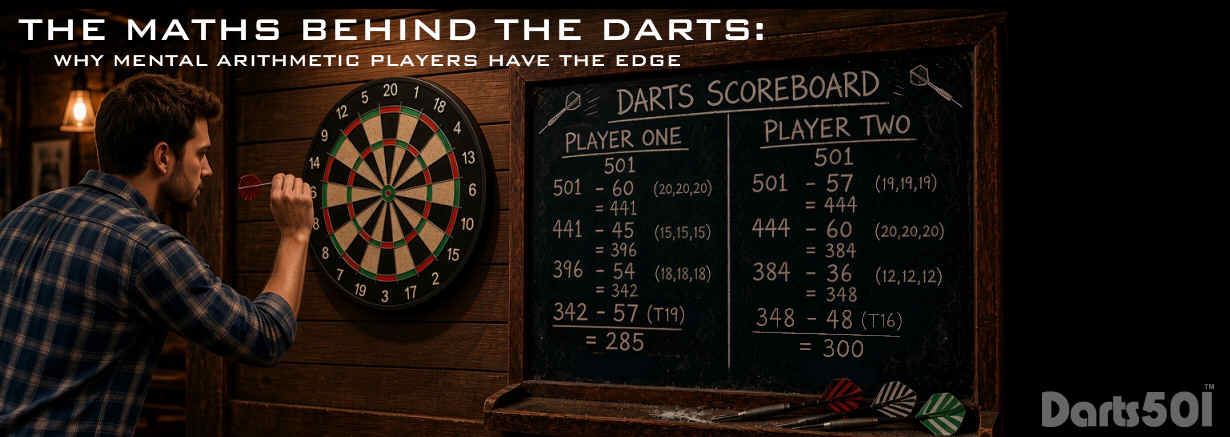
The Maths Behind Darts: Why Mental Arithmetic Players Have an Edge
Most people see darts as a test of hand and eye. That's true up to a point, but anyone who has played a serious game of 501 knows there's another skill quietly deciding matches. The best players are doing sums constantly, often faster than the person keeping score.
Mental arithmetic rarely gets the credit it deserves in darts. Yet the ability to subtract quickly and plan a finish without hesitation is often what separates confident players from those who freeze when the pressure builds.
Why Darts Is a Numbers Game at Heart
In a standard game of 501, every visit to the oche ends with a subtraction. Score 85 from 501, and you need to know instantly that 416 remains. Do that twenty times in a match while someone chats at your elbow and it becomes a genuine test.
It goes deeper than taking numbers away, though. The dartboard itself is laid out to punish careless thinking. The 20 sits between the 5 and the 1, so a slightly wayward dart aimed at the big scoring bed can cost you dearly. Players who understand the numbers around each segment make smarter choices about where to aim when their rhythm drops.
How Darts Checkouts Work
To win a leg, you must reach exactly zero, and your final dart has to land in a double or the bullseye. This is where arithmetic really earns its keep. The highest possible finish is 170, taken with two treble 20s followed by the bull.
Not every number can be finished in three darts. Scores such as 169 or 159 are known as bogey numbers, because no combination of three darts will check them out. A player who knows these by heart will steer well clear of leaving them, while a player working it out on the spot often realises too late.
Setting Up a Darts Finish: Thinking One Visit Ahead
Good players don't just look at the score in front of them. They plan what the next visit will leave behind. Double 16 is a favourite for exactly this reason. Leave 32 and, if your first dart drops into the single 16, you're still on a double with 16 remaining. Miss again into the single 8 and you're left on double 4. The number keeps halving, giving you several chances without needing to rethink.
Compare that with leaving an awkward odd number, which forces you to hit a single before you can even aim at a double. Thinking a visit ahead turns a scrappy finish into a straightforward one.
Mental Arithmetic Under Pressure on the Oche
Calculating takes up headspace, and headspace is exactly what you need for a smooth throw. If you're still working out your route as you raise the dart, your focus is split. This is why top professionals seem almost robotic with their checkouts. The maths has become automatic, leaving their full attention for the throw itself.
Plans also change mid-visit. Say you're on 81 and aim for treble 19, hoping to leave 24 for double 12. If the dart lands in the single 19 instead, you're on 62 with two darts in hand. A confident player switches straight to treble 10 and double 16 without breaking rhythm. Someone less sure stands there counting, and the moment is gone.
How Playing Darts Improves Your Maths Skills
The benefits stretch well beyond the pub. Plenty of teachers have used darts to bring arithmetic to life, because subtracting from 501 feels far more rewarding than a worksheet. Children who play regularly often become noticeably quicker at mental calculation without ever realising they've been practising.
For older players, keeping score is a pleasant way to keep the mind active. There's something satisfying about being the person at the table who can call the remaining score before anyone reaches for a pen.
Simple Ways to Sharpen Your Darts Maths
The quickest improvement comes from switching off the electronic scorer. Keep score yourself on a chalkboard, and you'll be practising arithmetic on every single visit. It feels slow at first, but most players speed up within a few weeks.
Learning a checkout chart is the natural next step. Start with finishes under 100, since these come up constantly, and work upwards once they feel second nature. You can also test yourself in idle moments by picking a random number and naming the route before checking it.
Building confidence with numbers can also extend beyond the dartboard, as tools such as an EV calculator provide another way to explore numerical values and practise interpreting calculations in different contexts.

Acknowledgements | Privacy, Cookies & Terms of Use | FAQ