



How Darts Crossed Into the World of Casino Gaming
The story told in Leeds is that in 1908 a landlord called Jim Garside, of the Adelphi Inn, was summoned before the magistrates for allowing a game of chance on his premises. The game was darts. His best thrower, William "Bigfoot" Annakin, is said to have put three darts into the 20 in court; the officials who tried to match him couldn't, and the case was dismissed because darts was plainly a game of skill. The magistrates' records for those years are lost, and the darts historian Patrick Chaplin thinks the case gets more credit than it deserves, but it's still the story darts tells about which side of the line it stands on.
A board built against luck
The numbering on a standard board is laid out to punish inaccuracy. The order of the numbers puts low scores beside high ones, 1 and 5 either side of the 20, 3 and 7 around the 19, so a dart that drifts is costly. The sequence is now credited to Thomas William Buckle, a wire and dartboard maker from Dewsbury, Yorkshire. All scholars of the sport have now dismissed references to Brain Gamlin as the inventor.
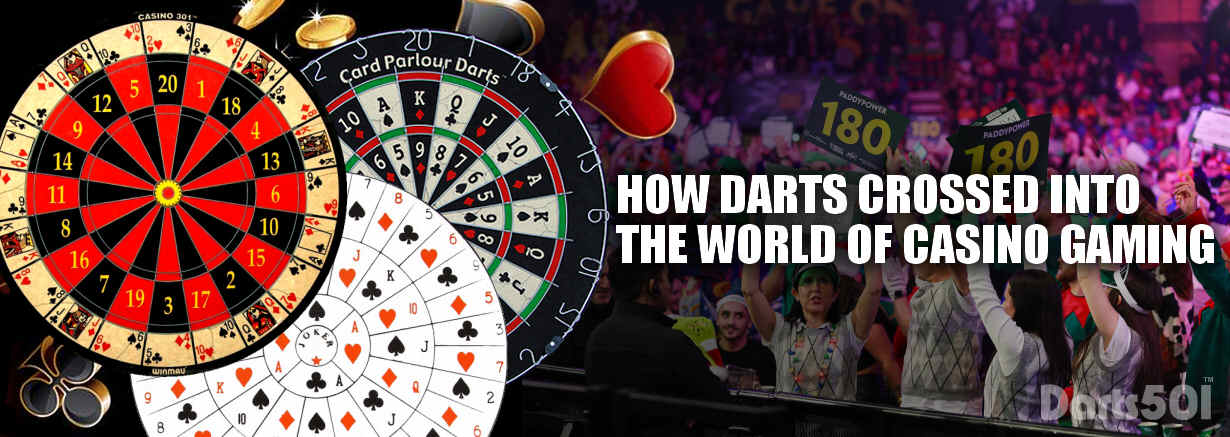
Darts and casino games have swapped parts before. Winmau once made a Casino 301 board, a standard dartboard with card suits printed across the segments, red for hearts and diamonds, black for spades and clubs, and it came with rules for darts versions of blackjack, roulette, baccarat, craps and keno. On that board, the casino game became a test of aim.
Now the traffic runs the other way, and many of the most popular slot games use the dartboard itself as a theme. On a reel, the board is a picture rather than a target, and the software settles every result.
The arithmetic of 501
From 501, three darts a visit, the highest possible checkout is 170, treble 20, treble 20, bull, and there's only one way to do it. Leave yourself 169, or any of the other bogey numbers below it (168, 166, 165, 163, 162 and 159), and you can't finish that visit however well you throw. There are 3,944 distinct sequences of darts that complete a nine-dart leg.
Where to aim depends on how good the thrower is. In a 2011 paper, Ryan Tibshirani, Andrew Price and Jonathan Taylor modelled throws with different amounts of scatter. A professional-standard player scores most at treble 20 and a moderate one at treble 19, while a beginner does best aiming a little below and to the left of the bull, where the misses land on generous numbers.
From the pub to the stage
The first World Championship was held at the Heart of the Midlands club in Nottingham in 1978, shown by the BBC, and won by Leighton Rees against John Lowe. In October 1984 Lowe threw the first nine-dart finish seen on television, ending on treble 17, treble 18, double 18, and took £102,000 for it.
At the start of 1988, 14 televised darts events aired across the BBC and ITV. A year later, there was one. In January 1992, 16 professionals formed the World Darts Council, which became the Professional Darts Corporation in 1997. Sky has televised the World Championship since the first one in the winter of 1993. Since 2008, it has been played at Alexandra Palace, where darts fans watch the professional players' incredible accuracy on the oche.

Acknowledgements | Privacy, Cookies & Terms of Use | FAQ