



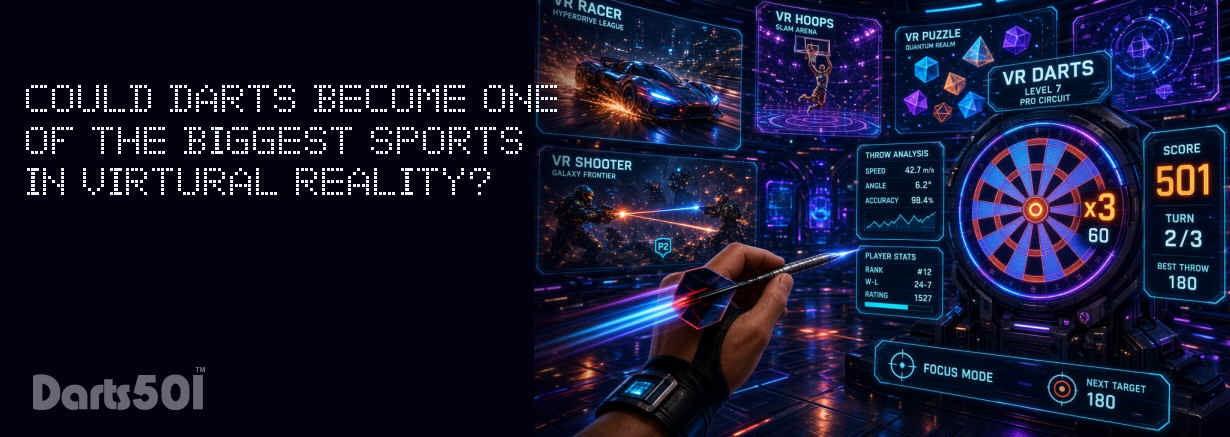
Could Darts Become One of the Biggest Sports in Virtual Reality?
Darts is currently enjoying a surge in interest thanks to digital entertainment and social media, which have helped open it up to a wider audience. Now, with virtual reality continuing to develop, the sport has the potential to become even bigger.
There have already been a few darts games in VR, and the physics used to simulate throwing mechanics are becoming increasingly sophisticated. Over time, darts could become a huge VR pastime.
Gaming Has Already Recreated Real-World Experiences
Ever since digital technology first emerged, developers have been trying to recreate real-world experiences online. In fact, it’s hard to think of a classic game or pastime now that hasn’t been transformed online. Traditional games like chess are now played online, and you can also find digital versions of Monopoly and Scrabble.
You may not believe this, but there are even games that bring the claw machine experience into digital gaming. This has been seen in the numerous Fluffy slots in the Fluffy Favourites franchise, which usually come with a claw machine-style special feature.
There have already been plenty of darts games that have used different mechanics to simulate the throw. These include the PDC World Championship Darts series, Pro Darts 2026, and Dart World Tour. Although these games have managed to engage loyal fanbases, they haven’t captured the act of physically throwing a dart.
Why Darts Is Naturally Suited to Virtual Reality
One of the main objectives of VR is to immerse users in digital versions of real-world experiences, and studios are already working on bringing darts to the masses in this format. There have been a few titles to date, including ForeVR Darts and On Target VR Darts in 2021.
More recently, Darts VR2: Bullseye was released in 2026, and it uses physics to replicate the way a real dart behaves when it’s thrown. This means that you don’t simply point at the dartboard and expect to hit your target. Instead, the game uses controller tracking to interpret factors including your hand movements, throwing speed, release timing, and angle.
Combining these elements to create a realistic throwing experience demonstrates why darts is particularly well suited to VR. Another advantage of the technology is that creators can offer a range of different environments for players to enjoy.
VR Darts Could Grow in the 2030s
Even though VR has been around for over a decade, it is still not mainstream. However, this could be set to change in the 2030s. According to market research, the VR market will grow at a CAGR of 27.5 percent between 2026 and 2033. If this happens, then the technology could become considerably more accessible to consumers over the next decade.
In this VR future, people may discover pastimes in this medium, in the same way that the online world has opened up access to more hobbies. Being able to play darts without having to install a dart board is an appealing prospect, and VR could introduce a whole new generation of players to the game.
Various sports are likely to be adapted into VR, but the physics-based nature of darts makes it one that could be perfectly replicated. As darts continues to attract more interest thanks to social media and short-form video content, more people may be encouraged to explore VR darts options.

Acknowledgements | Privacy, Cookies & Terms of Use | FAQ